
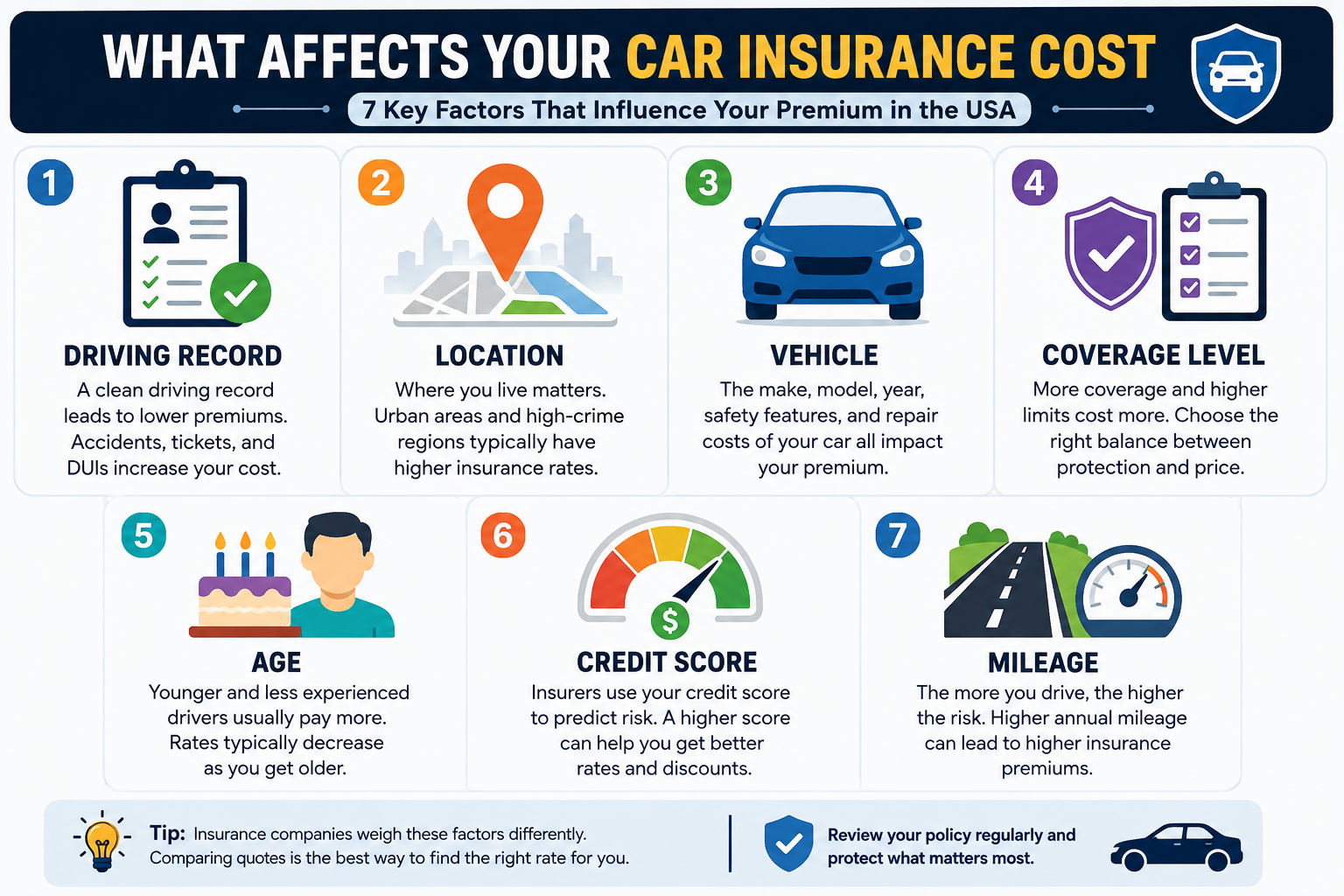
Car insurance costs vary so much from driver to driver that a single national average number rarely tells you anything useful about what you will pay. Your state, ZIP code, age, driving record, vehicle, credit-based insurance score (where allowed), and the coverage limits you choose all combine to set your premium — which is why two neighbors driving similar cars can have very different bills.
This guide explains exactly which factors drive your car insurance cost, how insurers calculate premiums, what typically makes a policy more or less expensive, and how to get an accurate number for your own situation. It intentionally does not publish a specific “average national premium” figure, because that number changes throughout the year, differs enormously by state, and any figure quoted here without live verification against a current, dated source would risk being outdated or misleading. Instead, this article shows you where to find that number reliably and how to interpret it.
Quick Answer / Key Takeaway
- There is no single accurate “average” car insurance cost — averages published by industry sources are typically calculated per state, per coverage level (minimum vs. full coverage), and per driver profile, and they’re updated on different schedules.
- The most reliable way to know your real cost is to get direct quotes from several insurers using identical coverage limits and deductibles.
- For a general benchmark, the National Association of Insurance Commissioners (NAIC) publishes countrywide and state-level average premium data, and the Insurance Information Institute (III) publishes consumer-facing summaries — check their current published figures directly rather than relying on a number in any single article, including this one.
- Full coverage (liability + collision + comprehensive) costs meaningfully more than liability-only or state-minimum coverage, but it also protects your own vehicle, not just others.
- The single biggest cost drivers are usually your driving record, your state/location, your vehicle, and your coverage limits — in roughly that order of impact for most drivers.
What Determines Car Insurance Cost?
Insurers price a policy based on the statistical likelihood and expected cost of a claim. The main factors are:
- Driving record — At-fault accidents, moving violations, and especially DUIs are typically the largest single factors that raise a premium, often for three to five years depending on the state and the violation.
- Location (state and ZIP code) — States set their own minimum coverage requirements and have different accident rates, litigation environments, weather risks, and repair costs, all of which affect base rates. Insurance is regulated at the state level, so the same company can charge very different rates in different states.
- Vehicle make, model, and age — Cars that are expensive to repair, have high theft rates, or perform poorly in safety tests generally cost more to insure. Vehicle safety features can also earn discounts.
- Coverage type and limits — Liability-only (state minimum) is the cheapest option; adding collision and comprehensive (“full coverage”) raises the premium but covers your own vehicle. Higher liability limits and lower deductibles both increase cost.
- Age and driving experience — Newer, younger drivers typically pay more due to statistically higher accident rates; rates generally decrease with age and experience, though they can rise again for senior drivers in some states.
- Credit-based insurance score — Used as a rating factor in most states. California, Hawaii, Massachusetts, and Michigan restrict or prohibit its use, so it does not apply there.
- Annual mileage and vehicle use — Higher annual mileage, long commutes, and rideshare/delivery use generally raise the premium because they increase exposure to risk.
- Marital status and household drivers — Married drivers often qualify for a discount, and adding a new, inexperienced driver to a household policy typically raises the total cost.
- Insurer and pricing model — Different companies weigh these factors differently, which is why quotes for identical coverage can vary significantly between insurers for the exact same driver.
How Insurers Calculate Your Premium
Auto insurers use actuarial models built from large pools of historical claims data to estimate:
- The probability you’ll file a claim
- The expected cost of that claim if it happens
- Administrative and overhead costs
- A profit margin, within limits set by state insurance regulators
Each state’s Department of Insurance reviews and approves the rating factors and rate changes insurers use, so the exact formula is not public, but the inputs listed above are well documented and consistent across the industry.
Example (illustrative only, not a real quote): Suppose two drivers live in the same state and drive similar sedans. Driver A has a clean record and drives 8,000 miles a year for a short commute. Driver B has one at-fault accident on record from two years ago and drives 20,000 miles a year for a longer commute. Even with identical coverage limits, Driver B will typically receive a meaningfully higher quote, because both the accident history and the higher mileage increase expected risk. The exact dollar difference depends entirely on the state and insurer.
What Affects Cost: Liability vs. Full Coverage
| Coverage Level | What’s Included | Relative Cost | Who It’s Usually Required For |
|---|---|---|---|
| State-minimum liability | Bodily injury and property damage liability only, at your state’s minimum limits | Lowest | Required for all drivers in nearly every state |
| Liability with higher limits | Same as above, but with higher payout limits | Moderate | Recommended for drivers with significant assets to protect |
| Full coverage (liability + collision + comprehensive) | Adds coverage for damage to your own vehicle from accidents, theft, weather, and other non-collision events | Highest | Typically required by lenders if you finance or lease your car |
Adding optional coverages — uninsured/underinsured motorist protection, personal injury protection (PIP) or medical payments coverage, rental reimbursement, roadside assistance, and gap insurance — each adds to the premium but can meaningfully reduce your out-of-pocket exposure after an accident.
What Isn’t Covered by a Standard Policy
- Mechanical breakdowns unrelated to a covered accident
- Normal wear and tear
- Intentional damage
- Business use of a personal vehicle without an added endorsement (rideshare driving in particular usually requires this)
- Racing or use on a closed course
- Damage that occurred before the policy’s effective date
Exclusions vary by insurer and state, so always review your specific policy documents.
Why This Article Doesn’t Publish a Specific Average Premium
Publishers and comparison sites sometimes cite a single “average annual premium” figure. Those figures are legitimate when they come from a dated, sourced report — but they:
- Change from year to year and sometimes mid-year as insurers file new rates
- Differ dramatically by state (often by a factor of two or three between the least and most expensive states)
- Differ depending on whether the average is for minimum liability or full coverage
- Can be calculated using different methodologies between publishers (median vs. mean, sample size, driver profile assumptions)
Because this article was written without live access to a current, dated data source, including a specific number here would risk giving you an outdated or misleading figure. The reliable path is described below.
How to Get an Accurate Cost Estimate for Yourself
- Check your state’s current minimum coverage requirements on your state Department of Insurance website, since these set your legal floor and directly affect the cheapest possible quote.
- Decide on your coverage level — minimum liability, liability with higher limits, or full coverage — based on your vehicle’s value, whether it’s financed, and how much personal asset protection you want.
- Request quotes from at least three to five insurers using identical limits and deductibles, so you’re comparing true apples to apples.
- Ask about every discount you might qualify for — multi-vehicle, multi-policy/bundling, good student, defensive driving course completion, low annual mileage, telematics/usage-based programs, and affiliation discounts (employer, alumni, military).
- Check the NAIC’s published state-level average premium data for a general benchmark of what your state’s overall averages look like, and compare that to your personal quotes.
- Re-shop annually or after a major life change — a move, a new vehicle, a paid-off car loan, a marriage, or an aging-off violation can all change your best available price.
Documents You’ll Typically Need for a Quote
- Driver’s license number for each driver on the policy
- Vehicle identification number (VIN) or year/make/model
- Current policy details, if you’re switching insurers (for a continuous-coverage discount)
- Estimated annual mileage
- Garaging address, if different from your mailing address
Common Mistakes That Inflate Your Cost Unnecessarily
- Letting coverage lapse between policies — a gap in coverage often raises future premiums and can trigger legal penalties.
- Comparing quotes with different limits or deductibles, which makes the “cheaper” quote meaningless.
- Not reporting all household drivers, which can lead to a denied claim if an unlisted driver is involved in an accident.
- Skipping the discount conversation — many drivers never ask which discounts they actually qualify for.
- Sticking with the same insurer out of habit — loyalty rarely produces the lowest available rate over time, since insurers adjust pricing models and competitors adjust their own rates independently.
- Choosing state-minimum liability without considering personal asset exposure — if you cause an accident that exceeds your liability limits, you can be personally responsible for the difference.
Important Things to Know
- Your rate is not fixed for the life of the policy. Insurers typically review and can adjust pricing at each renewal based on updated risk factors, even if you haven’t filed a claim.
- A not-at-fault accident can still affect future quotes in some cases, even if your current insurer doesn’t raise your rate, because it may appear on your claims history (CLUE report) that other insurers can access.
- Telematics/usage-based discounts aren’t guaranteed savings — safe driving data can lower your rate, but aggressive braking, hard acceleration, or high mileage can sometimes raise it, depending on the specific program’s terms.
- Credit-based insurance scoring is banned or restricted in a handful of states (California, Hawaii, Massachusetts, Michigan), so your cost drivers may differ if you live in one of these.
- The cheapest quote isn’t always the best value — check the insurer’s financial-strength rating (from AM Best, Moody’s, or S&P) so you know the company can reliably pay claims.
Frequently Asked Questions
How much does car insurance cost per month in the USA? This depends heavily on your state, driving record, vehicle, and coverage level, so there’s no single accurate national monthly figure. For a reliable estimate, request quotes for your specific situation and compare them against your state’s published average premium data from the NAIC or your state Department of Insurance.
Why is car insurance so expensive right now? Auto insurance costs are influenced by factors like vehicle repair costs, medical costs for injury claims, accident frequency, and state regulatory environments. These factors shift over time, which is why premiums can rise even for drivers with a clean record. For the latest explanation of national cost trends, check recent reports from the Insurance Information Institute or NAIC rather than relying on general assumptions.
What state has the cheapest car insurance? State-by-state cost rankings change as insurers file new rates, so this article does not list a fixed ranking. Your state Department of Insurance or the NAIC’s published state comparison data will have the most current figures.
Does my credit score really affect my car insurance rate? In most states, yes — insurers use a credit-based insurance score as one of several rating factors, based on statistical correlation with claims history. California, Hawaii, Massachusetts, and Michigan prohibit or restrict this practice.
Is full coverage worth the extra cost? It depends on your vehicle’s value and your financial situation. Full coverage (collision + comprehensive) protects your own vehicle, which matters more for a newer or financed car. For an older, low-value vehicle, some drivers decide the extra premium isn’t worth it relative to the car’s value — this is a personal financial decision, not a universal rule.
Will my rate go up if I file a claim? Often, yes, especially for at-fault accidents, though the exact impact varies by insurer, state, and whether you have accident forgiveness. Ask your insurer directly how a specific claim would affect your renewal price before deciding whether to file.
How can I lower my car insurance cost? Common ways include raising your deductible (which lowers your premium but increases your out-of-pocket cost per claim), bundling policies, asking about all available discounts, maintaining a clean driving record, and comparison shopping annually.
Does the type of car I drive change my premium significantly? Yes. Vehicles with higher repair costs, higher theft rates, or lower safety ratings generally cost more to insure, while vehicles with strong safety features can qualify for discounts.
Final Verdict
There’s no single honest answer to “how much does car insurance cost” — your real premium depends on your state, driving record, vehicle, coverage choices, and insurer. Rather than anchoring on a national average that may not reflect your situation, the most useful thing you can do is check your state’s current minimum requirements, decide on a coverage level that matches your vehicle and financial situation, and request quotes from several insurers using identical limits so you can compare real numbers. For a general benchmark before you shop, check the NAIC’s current published state-level premium data directly, since it’s updated on a regular cycle and reflects real filed rates rather than estimates.
Sources & References
- National Association of Insurance Commissioners (NAIC) — Auto insurance database and state premium data: https://www.naic.org
- Insurance Information Institute (III) — Consumer insurance cost education: https://www.iii.org
- Individual state Departments of Insurance — for current state minimum coverage requirements and rate filings
- AM Best — Insurer financial strength ratings: https://www.ambest.com
Note: This article does not cite a specific national or state average premium figure as a verified statistic, because live web verification was not available at the time of writing. Confirm current figures directly from the sources above before publishing any specific dollar amounts.