
Choosing a life insurance company is different from choosing an auto or home insurer, because the policy might not pay out for decades — so the insurer’s long-term financial strength matters as much as today’s premium. The “best” company also depends heavily on what you’re buying: term life, whole life, and universal life serve different needs, and the insurer that’s a great fit for a 30-year term policy isn’t necessarily the best fit for permanent coverage with cash value.
This guide explains how life insurance actually works, what separates term from permanent coverage, how insurers underwrite and price policies, and which major U.S. carriers are worth getting a quote from — including Northwestern Mutual, New York Life, MassMutual, Prudential, MetLife, State Farm, Guardian Life, Pacific Life, Lincoln Financial, and Transamerica. It does not publish specific premium figures, since actual cost depends on your age, health, coverage amount, and policy type, and changes with each insurer’s current rate filings.
Quick Answer / Key Takeaway
| If you want… | Consider |
|---|---|
| The lowest-cost way to cover a specific need (mortgage, income replacement, kids’ college years) | Term life insurance |
| Lifelong coverage with a cash-value component | Whole life or universal life insurance |
| A company with a long history of paying dividends to policyholders (mutual companies) | Northwestern Mutual, New York Life, MassMutual, Guardian |
| A simpler, no-medical-exam option for smaller coverage amounts | Simplified issue or guaranteed issue policies, offered by many carriers including some direct-to-consumer insurers |
| Strong customer satisfaction ratings | Check the latest J.D. Power life insurance studies before deciding, since rankings shift year to year |
| Bundling life insurance with an existing home/auto policy | State Farm, Allstate, Nationwide, and other multi-line insurers |
Note: this table reflects general company positioning based on business model and product mix, not a price or satisfaction ranking. Rankings on cost and satisfaction change and should be checked against current published data before you decide.
What Is Life Insurance?
Life insurance is a contract in which you (the policyholder) pay premiums to an insurer in exchange for a death benefit paid to your named beneficiaries when you die, as long as the policy is active. Some policy types also build cash value you can access while you’re alive. It exists to replace lost income, pay off debts, cover funeral costs, or leave an inheritance for the people who depend on you financially.
How Life Insurance Works
- You apply for a policy and choose a coverage amount (the death benefit) and a policy type.
- The insurer underwrites the application — reviewing your age, health history, lifestyle, and sometimes requiring a medical exam or health records — to assess risk and set your premium.
- If approved, you pay premiums on a schedule (monthly, quarterly, or annually) to keep the policy active (in force).
- If you die while the policy is in force, the insurer pays the death benefit to your named beneficiaries, generally income-tax-free under current federal law (consult a tax professional for your specific situation, since tax rules can change and have exceptions).
- For permanent policies with cash value, a portion of your premium may build value over time that you can potentially borrow against or withdraw, subject to policy terms.
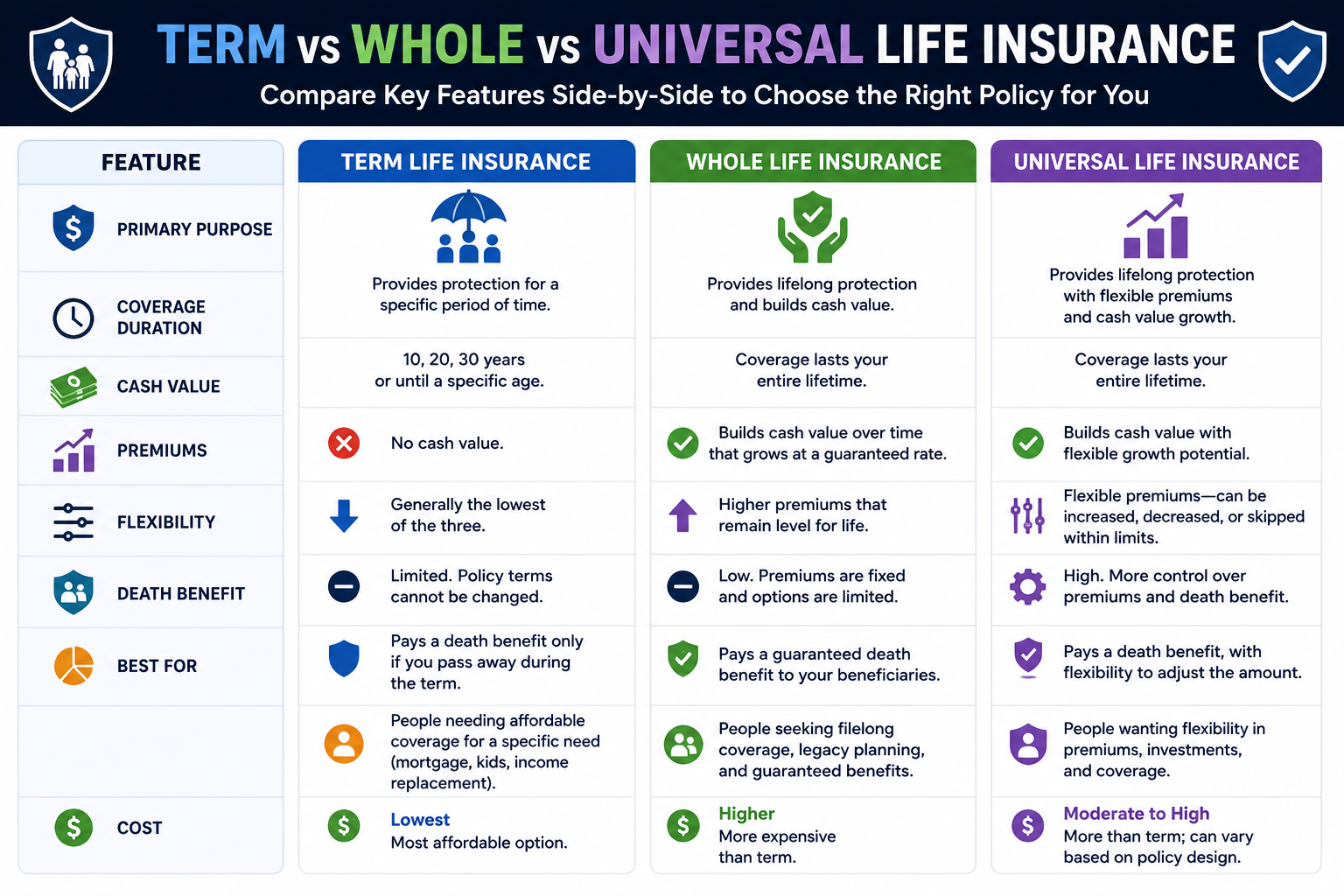
Term Life vs. Whole Life vs. Universal Life
| Feature | Term Life | Whole Life | Universal Life |
|---|---|---|---|
| Coverage duration | Fixed term (e.g., 10, 20, 30 years) | Lifelong, as long as premiums are paid | Lifelong, with flexible premiums |
| Cash value | None | Yes, grows at a guaranteed rate | Yes, growth can vary by policy design |
| Premium cost | Lowest, especially when young and healthy | Higher, level for life | Varies, can be adjusted within limits |
| Premium flexibility | Fixed, does not change during the term | Fixed | Flexible, within policy limits |
| Best for | Covering a specific time period of financial need (raising kids, paying off a mortgage) | Lifelong coverage plus a savings/cash-value component | Lifelong coverage with more flexibility in premiums and death benefit |
Example (illustrative only): Suppose a 35-year-old wants coverage until their mortgage is paid off and their children are financially independent. A 20-year term policy is often used for exactly this kind of time-limited need, because it’s typically the lowest-cost way to cover a specific period, rather than paying for lifelong coverage they may not need.
Who Is Eligible for Life Insurance?
Eligibility depends on the insurer and product, but generally:
- Most insurers set a maximum issue age (commonly somewhere between the mid-70s and mid-80s for many products, though this varies significantly by company and policy type — confirm directly with the insurer)
- Applicants typically go through health underwriting, which can include a medical exam, blood/urine tests, and a review of medical records and prescription history for fully underwritten policies
- Simplified issue policies skip the medical exam but ask health questions and usually cap the coverage amount lower
- Guaranteed issue policies (common for smaller final-expense amounts) don’t require health questions but usually cost more per dollar of coverage and may have a waiting period before the full death benefit applies
Because eligibility rules and age limits vary by company and change over time, always confirm current requirements directly with the insurer before assuming you qualify.
What Does Life Insurance Cover?
- Death benefit — the core payout to your beneficiaries
- Riders (optional add-ons), which commonly include:
- Accelerated death benefit, allowing early access to funds if diagnosed with a qualifying terminal illness
- Waiver of premium, which waives premiums if you become disabled
- Child term rider, adding small coverage for dependent children
- Guaranteed insurability rider, allowing you to buy more coverage later without new medical underwriting
Exact riders, their cost, and their terms vary significantly by insurer and policy, so confirm what’s actually offered and what it costs before assuming a rider is included.
What Is Not Covered / Common Exclusions
- Suicide within a contestability period (typically the first two years of the policy, though this varies by state and insurer) is often excluded or handled differently than standard death benefits
- Material misrepresentation on the application can result in a denied claim or policy rescission if discovered, generally within the contestability period
- Death from an excluded high-risk activity, if a specific exclusion was written into your policy (for example, some policies exclude or limit coverage for certain hazardous hobbies unless a rider was added)
- Lapsed policies — if premiums aren’t paid and the policy lapses without a grace period cure, there is no death benefit
Always read your specific policy’s contestability and exclusions sections, since terms vary by state and insurer.
Life Insurance Costs and Premiums
Premiums depend on:
- Age at application — younger applicants generally pay less
- Health status — underwriting class (e.g., preferred, standard) significantly affects price
- Coverage amount — higher death benefits cost more
- Policy type — term is generally cheapest; whole life and universal life cost more due to the cash-value component and lifelong duration
- Tobacco use — smokers typically pay substantially more than non-smokers
- Gender — statistically factored into pricing in most states
- Policy length (for term) — a 30-year term typically costs more than a 10-year term for the same coverage amount, since the insurer is on the hook longer
This article does not publish specific dollar premium figures, because actual cost depends entirely on your individual underwriting profile and each insurer’s current rate tables. For an accurate number, request quotes directly from insurers or through a licensed independent agent, who can compare multiple carriers for your specific health profile.
How to Buy Life Insurance: Step by Step
- Calculate your coverage need — common approaches include estimating 10–15 times your annual income, or adding up specific obligations (mortgage balance, remaining debt, children’s future education costs, funeral costs) minus existing savings and coverage.
- Decide on policy type — term for a specific time-limited need, or permanent (whole/universal) for lifelong coverage and cash value.
- Get quotes from multiple insurers — either directly or through a licensed independent agent who can compare carriers.
- Complete the application and underwriting process — this may include health questions, a medical exam, and authorization to review medical/prescription records.
- Review the policy illustration and contract carefully before signing, especially for permanent policies, since cash-value growth projections can include both guaranteed and non-guaranteed elements.
- Name and periodically review your beneficiaries, especially after major life events like marriage, divorce, or the birth of a child.
- Pay your first premium to put the policy in force, and confirm your effective date in writing.
Documents Commonly Requested
- Government-issued photo ID
- Social Security number
- Health history and current medications
- Information about your doctor(s) for medical record requests, if applicable
- Financial information, for larger coverage amounts (income verification may be requested)
- Beneficiary information (full legal names and relationship to you)
How to File a Life Insurance Claim
- The beneficiary contacts the insurer to report the death and request claim forms.
- The beneficiary submits a certified death certificate along with the completed claim form.
- The insurer reviews the claim, which may include a review for the contestability period if the death occurred within that window.
- Once approved, the insurer pays the death benefit to the named beneficiary, typically as a lump sum, though some insurers offer alternative payout options (installments or a retained-asset account).
- If a claim is delayed or denied, beneficiaries can ask the insurer for a written explanation and, if needed, file a complaint with the state Department of Insurance.
Common Mistakes to Avoid
- Waiting too long to apply. Premiums generally rise with age, and a health change can affect your underwriting class or eligibility entirely.
- Underinsuring by picking a coverage amount that doesn’t actually cover your dependents’ real financial need.
- Not disclosing accurate health information, which can lead to a denied claim later if discovered during underwriting or the contestability period.
- Letting a policy lapse by missing payments, especially for permanent policies where lapsing can also forfeit cash value under certain policy designs.
- Forgetting to update beneficiaries after a marriage, divorce, or birth.
- Confusing group life insurance through an employer with sufficient personal coverage — employer-provided policies are often limited in amount and typically don’t transfer if you leave the job, so many people supplement with an individual policy.
Major U.S. Life Insurers: How They Compare
Northwestern Mutual
A mutual insurer (owned by policyholders) known for whole life insurance and a long history of paying dividends, though dividends are not guaranteed. Sells primarily through a network of financial representatives.
New York Life
One of the largest mutual life insurers in the U.S., offering term, whole, and universal life. Also sells through a large network of agents and has a long operating history.
MassMutual (Massachusetts Mutual Life Insurance Company)
Another major mutual insurer with a strong presence in whole life and a dividend-paying history, plus term and universal life products.
Prudential Financial
A large, publicly traded insurer offering a broad range of term, universal, and variable universal life products, along with other financial products.
MetLife
Historically one of the largest life insurers in the U.S., though its structure and product focus have shifted over time (MetLife spun off much of its U.S. retail life insurance business into Brighthouse Financial in 2017) — confirm current product offerings directly with the company since corporate structure changes can affect which entity underwrites a given policy.
State Farm
Better known for auto and home insurance, but also offers term, whole, and universal life products, often appealing to customers who want to bundle with an existing agent relationship.
Guardian Life
A mutual insurer offering whole life, term, and universal life, along with a strong disability insurance product line.
Pacific Life
Known for a broad portfolio of universal and indexed universal life products, sold primarily through independent agents and financial advisors.
Lincoln Financial Group
Offers term, universal, and variable universal life, along with a range of other financial and retirement products.
Transamerica
Offers term and permanent life products and is known for competitive term life pricing in some underwriting classes, though this should be confirmed with a current quote.
Important: Financial-strength ratings (AM Best, Moody’s, S&P) and product availability change over time and vary by state. Confirm a company’s current rating directly with the rating agency, and confirm current product availability and terms directly with the insurer or a licensed agent, before applying.
Life Insurance Company Comparison Table
| Insurer | Structure | Notable Product Strength | Best For |
|---|---|---|---|
| Northwestern Mutual | Mutual | Whole life, dividend history | Long-term, dividend-focused permanent coverage |
| New York Life | Mutual | Broad term/whole/universal lineup | Buyers who want an agent relationship and long operating history |
| MassMutual | Mutual | Whole life, dividends | Permanent coverage with cash value focus |
| Prudential | Publicly traded | Broad term and universal life range | Buyers wanting flexible product options |
| MetLife | Publicly traded | Historic scale (note 2017 Brighthouse spinoff) | Confirm current retail product lineup directly |
| State Farm | Multi-line insurer | Bundling with auto/home | Existing State Farm customers wanting one agent |
| Guardian Life | Mutual | Whole life + disability insurance | Buyers wanting permanent life and disability coverage together |
| Pacific Life | Publicly held | Universal and indexed universal life | Buyers interested in permanent, flexible-premium coverage |
| Lincoln Financial | Publicly traded | Universal and variable universal life | Buyers wanting a wide product and rider selection |
| Transamerica | Publicly traded (Aegon subsidiary) | Term life | Buyers prioritizing term coverage — compare current quotes |
This table reflects general company positioning, not a price or satisfaction ranking. Always confirm current financial-strength ratings, product availability, and pricing directly before applying.
Pros and Cons: Mutual vs. Publicly Traded Insurers
Mutual insurers (Northwestern Mutual, New York Life, MassMutual, Guardian)
- Pros: Owned by policyholders, historically associated with paying dividends on participating whole life policies (dividends are not guaranteed)
- Cons: Often sold through a dedicated agent model, which can mean less price competition shopping compared to direct online options
Publicly traded insurers (Prudential, MetLife, Lincoln Financial, Pacific Life, Transamerica)
- Pros: Broad product lines, often more flexible universal life designs
- Cons: No policyholder dividends in the same way mutual companies offer on participating policies
Important Things to Know
- A medical exam isn’t always required. Many insurers now offer accelerated or simplified underwriting for certain age and coverage-amount combinations, using data sources instead of a traditional exam — ask each insurer what their current underwriting process looks like.
- Term policies are usually convertible. Many term policies include a conversion privilege allowing you to convert some or all of the coverage to a permanent policy without new medical underwriting, within a specified window — confirm this feature and its deadline with your specific policy.
- Group life insurance through work is often not portable. If you leave your employer, employer-provided coverage typically ends or requires conversion at a higher individual rate, so many financial planners recommend not relying on it as your only coverage.
- Cash-value growth illustrations often include non-guaranteed elements. When reviewing a permanent policy illustration, ask which numbers are guaranteed and which are projections based on current, non-guaranteed assumptions.
- State guaranty associations provide a safety net, but with limits that vary by state, if an insurer becomes insolvent — this is separate from and in addition to checking an insurer’s financial-strength rating before buying.
Frequently Asked Questions
Which life insurance company is best? There’s no single best company for everyone — it depends on whether you want term or permanent coverage, your health profile, and your budget. Mutual insurers like Northwestern Mutual, New York Life, and MassMutual are well known for whole life and dividend history; other insurers like Prudential and Lincoln Financial offer strong universal life flexibility. Compare quotes and financial-strength ratings for your specific situation.
How much life insurance do I need? A common starting approach is 10–15 times your annual income, adjusted for specific obligations like a mortgage balance, other debts, and future costs such as children’s education, minus existing savings and coverage. A licensed financial advisor or insurance agent can help calculate a more precise number for your situation.
Is term or whole life insurance better? Neither is universally “better” — term is typically the lowest-cost way to cover a specific time period of need, while whole life provides lifelong coverage plus a cash-value component at a higher premium. The right choice depends on your goals, budget, and whether you want a savings component built in.
Can I be denied life insurance? Yes. Insurers can decline an application based on health conditions, high-risk occupations or hobbies, or other underwriting factors, though many people who are declined for fully underwritten policies can still qualify for simplified or guaranteed issue policies, typically at a higher cost per dollar of coverage.
Do I need a medical exam for life insurance? Not always. Many insurers now offer no-exam underwriting for certain age ranges and coverage amounts using health data and records instead of a physical exam, while larger coverage amounts or older applicants may still require one. Requirements vary by insurer.
Is the death benefit taxable? Generally, life insurance death benefits are paid income-tax-free to beneficiaries under current federal law, though there are exceptions (for example, if the policy was transferred for value, or in certain estate tax situations for large estates). Consult a tax professional for guidance specific to your situation, since tax law can change.
What happens if I stop paying premiums? For term life, the policy typically lapses after a grace period, ending coverage. For permanent policies with cash value, some policies allow using accumulated cash value to cover premiums for a period, depending on the policy’s specific terms — check your contract or ask your insurer directly.
Can I have more than one life insurance policy? Yes, many people hold multiple policies — for example, an employer group policy plus an individual term policy — as long as total coverage is reasonably justified relative to insurable interest and financial need, which insurers evaluate during underwriting for larger amounts.
Final Verdict
The best life insurance company for you depends on what you’re trying to accomplish: term life from a competitively priced insurer if you need coverage for a specific period, or a mutual insurer like Northwestern Mutual, New York Life, MassMutual, or Guardian if you want permanent coverage with a dividend-paying history. Before applying, calculate your actual coverage need, decide between term and permanent coverage, compare quotes from multiple insurers or through a licensed independent agent, and check each company’s current financial-strength rating so you know the insurer will be positioned to pay a claim decades from now.
Sources & References
- National Association of Insurance Commissioners (NAIC) — Life insurance consumer resources: https://www.naic.org
- AM Best — Insurance company financial strength ratings: https://www.ambest.com
- Insurance Information Institute (III) — Life insurance consumer education: https://www.iii.org
- Individual state Departments of Insurance and state guaranty association resources
- Individual insurer official websites (Northwestern Mutual, New York Life, MassMutual, Prudential, MetLife, State Farm, Guardian Life, Pacific Life, Lincoln Financial, Transamerica) for current product and underwriting details
Note: This article does not cite specific premium figures, market-share data, or satisfaction scores as verified current statistics, since live web verification was not available at the time of writing. Confirm current figures directly from the sources above, or from each insurer, before publishing any specific numbers.