
Choosing an auto insurer usually comes down to three things: price, coverage, and how the company treats you when you actually file a claim. The problem is that no single company is “the best” for everyone — a driver with a clean record in Ohio and a driver with a recent accident in California will get very different quotes from the same insurer.
This guide compares the auto insurers that consistently rank among the largest and most widely available in the United States — including GEICO, State Farm, Progressive, Allstate, USAA, Liberty Mutual, Nationwide, Farmers, American Family, and Travelers — based on their business model, coverage options, discount structure, and financial strength ratings.
It does not publish specific premium dollar amounts because real premiums depend on your state, driving history, vehicle, credit-based insurance score (where allowed), and coverage limits, and they change throughout the year. For an accurate price, you’ll need a direct quote — this article tells you which companies are worth getting a quote from and why.
Quick Answer / Key Takeaway
| If you want… | Consider |
|---|---|
| Lowest starting rates for many drivers | GEICO, Progressive |
| Strong local agent network and bundling | State Farm, Allstate, Farmers, American Family |
| Military members and their families | USAA (eligibility required) |
| Usage-based / pay-as-you-drive discounts | Progressive (Snapshot), Allstate (Drivewise), Nationwide (SmartRide) |
| High-risk or nonstandard drivers | Progressive, State Farm (state-dependent) |
| Strong claims-paying financial strength | USAA, State Farm, Progressive (all rated A++ or A+ by AM Best as of their most recent published ratings) |
| Bundling home + auto for savings | State Farm, Allstate, Nationwide, Liberty Mutual |
Note: rankings by lowest price shift constantly and vary by state, so treat this table as a starting point for which companies to quote, not a guarantee of the cheapest rate.
What Determines the “Best” Auto Insurance Company?
There’s no single objective ranking because insurers price risk differently. What matters is matching a company’s strengths to your situation:
- Price competitiveness for your specific risk profile (age, location, driving record, vehicle type)
- Financial strength, meaning the company’s demonstrated ability to pay claims — tracked by independent rating agencies like AM Best, Moody’s, and S&P
- Coverage options, such as accident forgiveness, new-car replacement, gap insurance, and rideshare coverage
- Claims experience, including how the company is perceived for speed and fairness of claims handling
- Availability, since not every insurer sells in every state, and some (like USAA) restrict who can buy a policy
How Auto Insurance Pricing Works
Auto insurers use actuarial data to estimate the likelihood and cost of a claim, then price policies accordingly. Common rating factors include:
- Driving record — accidents, tickets, and DUIs raise rates significantly
- Location — insurers price by state and often by ZIP code, reflecting local accident rates, theft rates, weather risk, and litigation costs
- Vehicle — the make, model, age, and safety features affect both collision-repair costs and theft risk
- Coverage limits and deductibles — higher liability limits and lower deductibles increase premiums
- Credit-based insurance score — used in most states (not California, Hawaii, Massachusetts, or Michigan, which restrict or ban the practice) as one factor among several
- Age and driving experience — newer and younger drivers typically pay more
- Annual mileage and vehicle use — commuting long distances or using the vehicle for rideshare work raises risk exposure
Because these factors interact, the same driver can see a large price difference between insurers even for identical coverage — which is why comparison shopping matters more than picking a single “best” brand.
Who Should Compare Auto Insurance Quotes?
Nearly every driver benefits from shopping around periodically, but it especially pays off for:
- Drivers renewing a policy after a rate increase
- Anyone who has moved to a new state or ZIP code
- Drivers who recently bought a new vehicle
- Anyone whose driving record has improved (tickets or accidents aging off, typically after 3–5 years depending on the state and violation)
- People who recently married, since many insurers offer a marital discount
- Households considering bundling auto with home, renters, or umbrella coverage
Main Types of Auto Coverage
| Coverage Type | What It Does | Required? |
|---|---|---|
| Liability (bodily injury & property damage) | Pays for injuries/damage you cause to others | Required in nearly all states (minimums vary by state) |
| Collision | Pays for damage to your own car after an accident | Optional, often required if you have a car loan/lease |
| Comprehensive | Pays for non-collision damage (theft, fire, weather, animal strikes) | Optional, often required if you have a car loan/lease |
| Uninsured/Underinsured Motorist | Pays if the at-fault driver has no or insufficient insurance | Required in some states, optional in others |
| Personal Injury Protection (PIP) / Medical Payments | Covers medical costs regardless of fault | Required in no-fault states |
| Gap Insurance | Covers the difference between what you owe and the car’s actual cash value after a total loss | Optional, useful for financed/leased vehicles |
Minimum liability limits are set individually by each state’s Department of Insurance and change periodically, so always confirm your state’s current minimum rather than relying on older articles.
What Isn’t Typically Covered
Standard auto policies generally exclude:
- Mechanical breakdowns unrelated to a covered accident (a separate mechanical breakdown or extended warranty product covers this)
- Regular wear and tear
- Damage from intentional acts
- Business use of a personal vehicle in most cases (rideshare driving usually requires an added endorsement or separate policy)
- Racing or use on a closed course
- Damage that occurred before the policy started
Always read your specific policy’s exclusions section — these vary by insurer and by state.
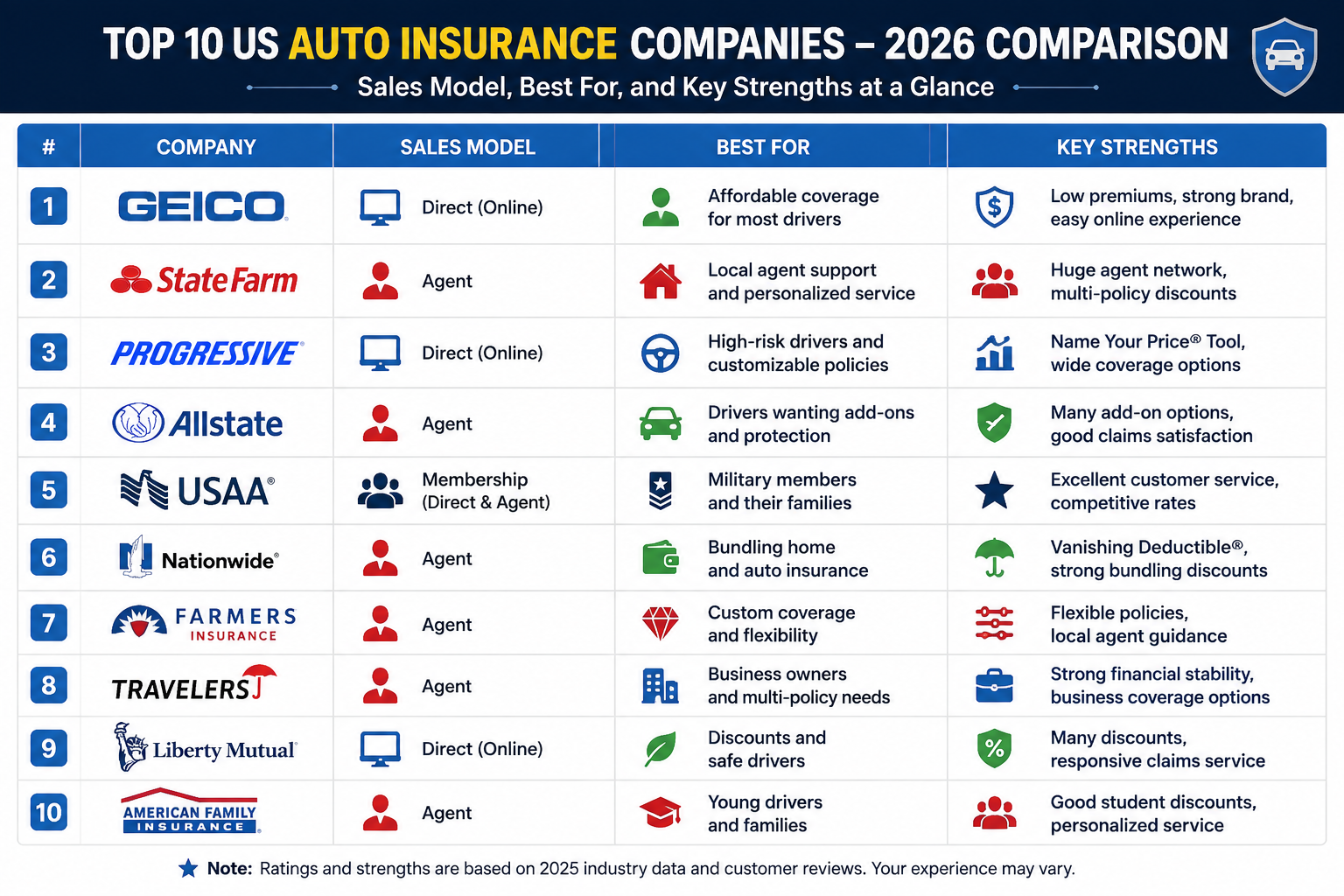
Major U.S. Auto Insurers: How They Compare
GEICO
Sells primarily direct-to-consumer online and by phone, with a smaller network of agents than traditional carriers. Known for aggressive rate competitiveness for lower-risk drivers and a broad set of standard discounts (multi-vehicle, federal employee, military, good student, defensive driving). Backed by Berkshire Hathaway, which contributes to strong financial-strength ratings.
State Farm
The largest auto insurer in the U.S. by market share, according to National Association of Insurance Commissioners (NAIC) market-share data. Sells primarily through a large network of local exclusive agents, which appeals to drivers who want a dedicated agent relationship. Strong bundling discounts with home and life insurance.
Progressive
Known for pioneering usage-based insurance (Snapshot) and for the “Name Your Price” quote tool. Sells both directly and through independent agents. Often competitive for drivers with a less-than-perfect record and for high-mileage drivers, since it uses a wide range of risk tiers.
Allstate
Sells mainly through exclusive agents, with the Esurance/Allstate direct channel also available in some states. Offers Drivewise, a telematics-based discount program, and accident forgiveness add-ons. Strong bundling options.
USAA
Consistently rated highly for customer satisfaction in independent surveys (such as J.D. Power’s auto insurance studies), but membership is restricted to active-duty military, veterans, and their immediate families. Not available to the general public.
Liberty Mutual
Offers highly customizable coverage with a wide range of optional add-ons (new-car replacement, better car replacement, accident forgiveness). Sells through agents, direct channels, and online.
Nationwide
Offers the SmartRide telematics program and vanishing deductible options. Strong presence in bundling home and auto coverage.
Farmers Insurance
Sells primarily through independent and exclusive agents. Offers a Signal telematics app and a range of specialty coverage options, including classic car and RV insurance through affiliated brands.
American Family Insurance
Regional in scope compared to national carriers (available in a more limited set of states), sold through exclusive agents, with strong bundling and loyalty discounts.
Travelers
Offers IntelliDrive telematics and a broad set of discounts, often competitive for drivers who bundle multiple policies. Sold through independent agents.
Important: Financial-strength ratings (from AM Best, Moody’s, or S&P) and market-share rankings change over time. Before buying, check the insurer’s current rating directly on the rating agency’s website and confirm current availability in your state, since some of these companies do not sell in every state.
Auto Insurance Comparison Table
| Insurer | Sales Model | Notable Strength | Best For | Availability |
|---|---|---|---|---|
| GEICO | Direct online/phone | Competitive base rates, broad discounts | Budget-conscious, low-risk drivers | Nationwide |
| State Farm | Exclusive agents | Largest market share, strong bundling | Drivers who want a local agent | Nationwide |
| Progressive | Direct + independent agents | Usage-based discounts, wide risk tiers | High-mileage or nonstandard drivers | Nationwide |
| Allstate | Exclusive agents + direct | Telematics discounts, accident forgiveness | Drivers wanting add-on flexibility | Nationwide |
| USAA | Direct | Top-rated customer satisfaction | Military members and families only | Restricted eligibility |
| Liberty Mutual | Agents + direct | Highly customizable add-ons | Drivers who want tailored coverage | Nationwide |
| Nationwide | Agents + direct | SmartRide telematics, vanishing deductible | Bundlers | Most states |
| Farmers | Agents | Specialty vehicle coverage | Drivers with unique vehicles | Most states |
| American Family | Exclusive agents | Regional loyalty discounts | Drivers in supported states | Limited states |
| Travelers | Independent agents | IntelliDrive telematics, bundling | Multi-policy households | Most states |
This table reflects general company positioning based on publicly available information about each insurer’s business model and offerings. It is not a price ranking. Get a personalized quote from each company for an accurate cost comparison.
Costs, Premiums, and Fees
Because auto insurance premiums vary by state, ZIP code, driving history, vehicle, and coverage selected, this article does not publish specific national average premium figures — any number presented as a flat national average would obscure more than it reveals and can quickly go out of date.
For current, verifiable premium data, use these approaches instead:
- Request direct quotes from at least three to five insurers for identical coverage limits and deductibles
- Check your state Department of Insurance website — many publish average rate comparisons by ZIP code or company
- Review the NAIC’s countrywide data on its official site
- Ask your current insurer for a renewal breakdown showing what changed and why
Common fees to ask about before buying:
- Down payment vs. full-pay discount
- Installment/payment plan fees
- Cancellation fees
- Late payment fees
- SR-22 filing fees, if applicable
How to Buy Auto Insurance: Step by Step
- Gather your information — driver’s license numbers for all household drivers, vehicle identification numbers (VINs), current policy details, and your driving history.
- Decide on coverage limits — check your state’s minimum liability requirements, then decide whether you want higher limits and full coverage (collision + comprehensive).
- Request quotes from multiple insurers — use identical coverage limits and deductibles across quotes so you’re comparing like for like.
- Ask about all applicable discounts — multi-vehicle, multi-policy, good student, defensive driving course, low mileage, telematics programs, and affiliation discounts (employer, alumni association, military).
- Review the policy declarations page carefully before purchasing — confirm coverage limits, deductibles, and named drivers/vehicles are correct.
- Set your payment plan and confirm your effective date.
- Cancel your old policy only after the new policy’s effective date is confirmed, to avoid a coverage gap.
Documents Commonly Requested
- Driver’s license for each listed driver
- Vehicle registration or VIN
- Proof of prior insurance (for continuous-coverage discounts)
- Odometer reading (for some insurers/states)
- Garaging address, if different from your mailing address
How to File a Claim
- Ensure everyone is safe and call emergency services if needed.
- Document the scene: photos, other driver’s information, and a police report number if applicable.
- Report the claim to your insurer as soon as possible, by phone or through the company’s app/website.
- Provide your claim adjuster with all requested documentation.
- Get repair estimates — many insurers have a network of approved repair shops, but you’re generally free to choose your own shop unless your state or policy specifies otherwise.
- Track your claim status through the insurer’s app or by staying in contact with your adjuster.
Common Mistakes to Avoid
- Only comparing the sticker price, not the coverage limits and deductibles behind it — a cheaper quote with lower limits isn’t actually a better deal.
- Letting coverage lapse between policies, which can raise future premiums and, in some states, trigger penalties.
- Underinsuring by choosing only state-minimum liability limits without considering your personal asset exposure in an at-fault accident.
- Not reporting all household drivers, which can lead to a claim denial if an unlisted driver is involved in an accident.
- Ignoring available discounts — many drivers never ask about all the discounts they qualify for.
- Not re-shopping periodically — loyalty rarely results in the lowest available rate over time.
Pros and Cons by Insurer Type
National insurers with agent networks (State Farm, Allstate, Farmers, American Family)
- Pros: Local support, strong bundling, personalized service
- Cons: Rates can be less competitive for straightforward, low-risk profiles compared to direct insurers
Direct-to-consumer insurers (GEICO, Progressive)
- Pros: Often lower base rates, fast online quoting
- Cons: Less in-person support; claims handled remotely
Restricted-membership insurers (USAA)
- Pros: Consistently high customer satisfaction ratings
- Cons: Not available to the general public
Important Things to Know
- State laws override marketing claims. Minimum coverage requirements, no-fault rules, and credit-scoring restrictions differ by state and directly affect which insurer and coverage make sense for you.
- Telematics programs aren’t guaranteed savings. Usage-based programs (Snapshot, Drivewise, SmartRide, IntelliDrive) can lower your rate for safe driving, but aggressive braking, hard acceleration, or high mileage can sometimes raise it, depending on the program’s terms.
- Bundling isn’t automatically cheaper. Always compare the bundled price against separate best-in-class quotes for auto and home/renters insurance.
- Financial strength ratings matter for claims-paying ability, not just price. Check current ratings directly from AM Best, Moody’s, or S&P before finalizing your choice, since ratings are updated periodically.
- Rate increases after a claim vary by insurer and state, and some insurers offer accident forgiveness that prevents a first at-fault claim from raising your rate.
Frequently Asked Questions
Which auto insurance company is cheapest? There’s no single cheapest insurer for everyone. GEICO and Progressive are frequently competitive for lower-risk drivers, but the cheapest option depends on your state, driving record, and vehicle. Always compare multiple quotes.
Which company has the best customer satisfaction? USAA has consistently scored well in independent studies such as J.D. Power’s auto insurance satisfaction surveys, but it’s only available to military members, veterans, and their families. Among insurers open to the general public, satisfaction rankings shift year to year — check the latest published study before deciding.
Is it worth bundling home and auto insurance? Often, but not always. Bundling can produce a meaningful discount with insurers like State Farm, Allstate, and Nationwide, but you should still compare the bundled total against the best available separate quotes.
How often should I compare auto insurance quotes? Most drivers benefit from re-shopping every 6 to 12 months, and especially after a renewal price increase, a move, a new vehicle purchase, or a change in driving record.
Does my credit score affect my auto insurance rate? In most states, yes — insurers use a credit-based insurance score as one rating factor. California, Hawaii, Massachusetts, and Michigan restrict or prohibit this practice, so it doesn’t apply there.
What’s the difference between liability-only and full coverage? Liability-only pays for damage and injuries you cause to others; it does not pay to repair or replace your own vehicle. Full coverage adds collision and comprehensive coverage, which pays for damage to your own car.
Will my rate go up after an accident that wasn’t my fault? It depends on the insurer and state. In many cases, a not-at-fault accident shouldn’t raise your rate, but insurers vary in how they apply this, and it can still appear on your claims history (CLUE report), which future insurers may consider.
Can I switch insurers mid-policy? Yes. Most insurers allow you to cancel at any time, though some charge a short-rate cancellation fee. Time the switch so your new policy’s effective date starts before you cancel the old one, to avoid a coverage gap.
Final Verdict
There’s no universal “best” auto insurance company — the right choice depends on your driving record, location, vehicle, and priorities. GEICO and Progressive are frequently strong starting points for competitive base pricing, State Farm and Allstate for drivers who value a local agent and bundling, and USAA for eligible military families seeking top-rated service. The most reliable way to find the best deal for your situation is to request quotes from at least three to five insurers with identical coverage limits, check each company’s current financial-strength rating, and re-shop annually rather than assuming your current policy is still competitively priced.
Sources & References
- National Association of Insurance Commissioners (NAIC) — Market share and industry data: https://www.naic.org
- AM Best — Insurance company financial strength ratings: https://www.ambest.com
- Insurance Information Institute (III) — Consumer insurance education and statistics: https://www.iii.org
- J.D. Power — Auto insurance customer satisfaction studies: https://www.jdpower.com
- Individual insurer official websites (GEICO, State Farm, Progressive, Allstate, USAA, Liberty Mutual, Nationwide, Farmers, American Family, Travelers) for current product and coverage details
Note: This article does not cite specific premium figures, market-share percentages, or satisfaction scores as verified statistics because live web verification was not available at the time of writing. Readers and editors should confirm current figures directly from the sources above before publishing any specific numbers.