
Health insurance shopping trips up more people than almost any other insurance decision, because the “best” plan isn’t about brand name — it’s about matching plan type, network, and cost structure to how much healthcare you actually expect to use. A plan with a low monthly premium can end up costing more over a year than a plan with a higher premium, depending on your deductible, your doctors, and how often you see them.
This guide breaks down the plan types available in the U.S. (HMO, PPO, EPO, POS, and high-deductible health plans), what actually drives your out-of-pocket cost, how ACA Marketplace plans and employer coverage differ, and exactly what to compare before you enroll. It does not publish specific 2026 premium amounts, subsidy income thresholds, or enrollment deadlines, because those figures are set and updated annually by the federal government and individual states, and this article was written without live access to verify the current numbers. For those specifics, this guide points you to HealthCare.gov and your state’s exchange, which are the authoritative, current sources.
Quick Answer / Key Takeaway
- The “best” health insurance plan depends on your expected healthcare use, your preferred doctors/hospitals, and your budget — there’s no single best plan for everyone.
- Where you get coverage matters as much as the plan type: employer-sponsored insurance, the ACA Marketplace, Medicaid, Medicare, or a private individual plan all have different rules, cost structures, and enrollment windows.
- Compare these five things for any plan: monthly premium, deductible, out-of-pocket maximum, network type, and whether your specific doctors and medications are covered.
- Metal tiers on the ACA Marketplace (Bronze, Silver, Gold, Platinum) indicate the cost-sharing split between you and the insurer, not the quality of care.
- Open enrollment dates, subsidy eligibility, and premium amounts change annually — always confirm current figures directly on HealthCare.gov or your state’s exchange before enrolling.
What Is Health Insurance?
Health insurance is a contract in which you (and often your employer, if applicable) pay a premium to an insurer, and in exchange, the insurer pays some or most of your covered medical costs, subject to a deductible, copayments, coinsurance, and an annual out-of-pocket maximum. In the U.S., coverage comes through several distinct systems — employer-sponsored plans, the ACA Marketplace, Medicaid, Medicare, and private individual/family plans — each with different eligibility rules and enrollment periods.
How Health Insurance Works
- You choose a plan during an eligible enrollment period (employer open enrollment, ACA Marketplace open enrollment, or a qualifying life event that opens a special enrollment period).
- You pay a monthly premium to keep the plan active, regardless of whether you use medical care that month.
- When you receive care, you typically pay toward your deductible first (the amount you pay before the plan starts sharing costs), except for certain services like preventive care, which is generally covered without cost-sharing under ACA-compliant plans.
- After meeting your deductible, you typically pay a copayment (a fixed dollar amount) or coinsurance (a percentage of the cost) for covered services, and the insurer pays the rest.
- Once your total out-of-pocket spending for the year reaches your plan’s out-of-pocket maximum, the insurer pays 100% of covered, in-network costs for the rest of the plan year.
Example (illustrative only): Suppose a plan has a $2,000 deductible and 20% coinsurance after the deductible. If a policyholder has a $5,000 medical bill for a covered service, they would generally pay the first $2,000 (deductible), then 20% of the remaining $3,000 ($600), for a total of $2,600 out of pocket — assuming the out-of-pocket maximum hasn’t already been reached. The exact numbers on any real plan will differ; this is only an illustration of how deductibles and coinsurance interact.
Main Types of Health Plans
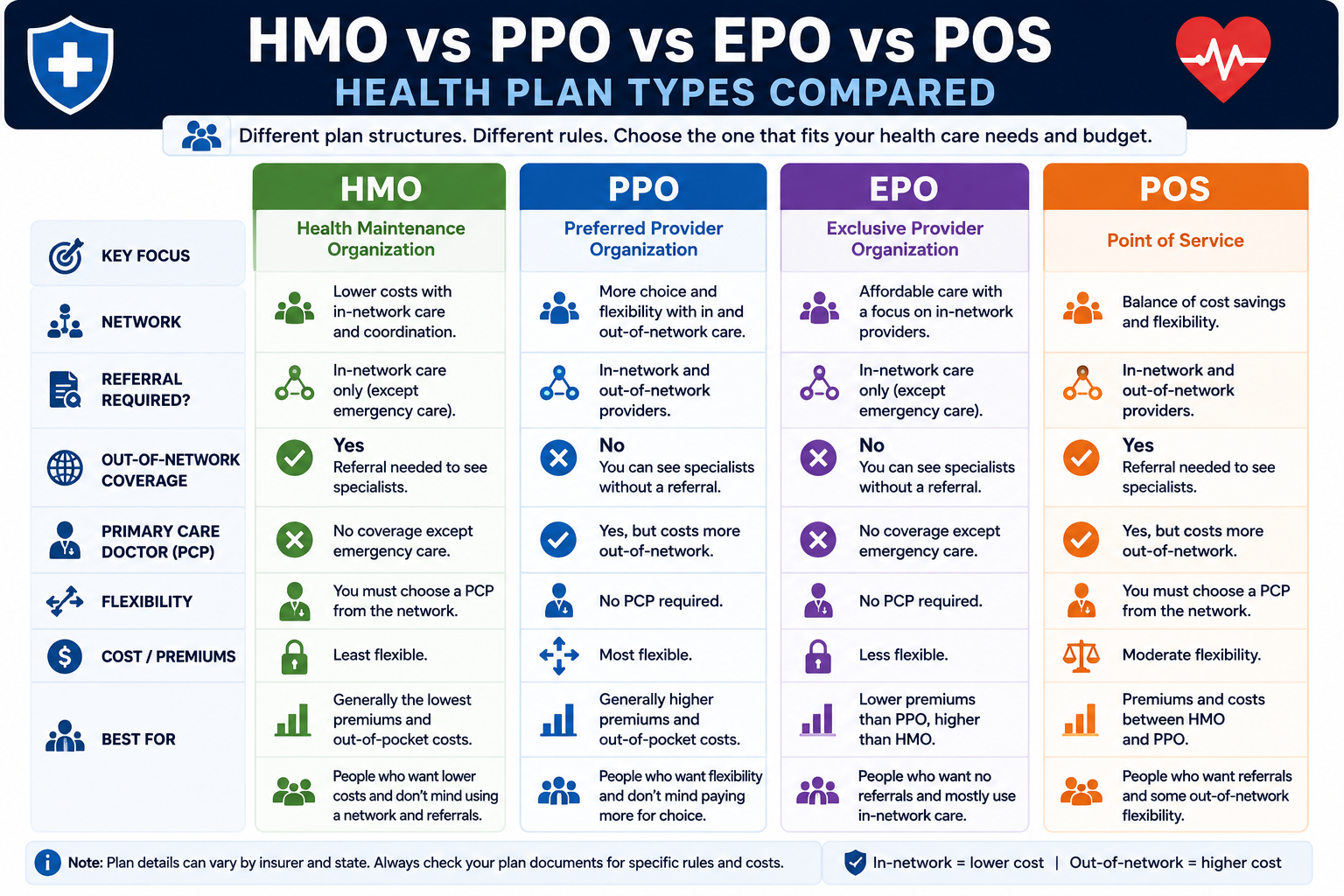
| Plan Type | How It Works | Referral Needed? | Out-of-Network Coverage |
|---|---|---|---|
| HMO (Health Maintenance Organization) | Requires a primary care provider (PCP); care is generally coordinated through the PCP | Usually yes, for specialists | Usually not covered except emergencies |
| PPO (Preferred Provider Organization) | Broader network flexibility, no PCP requirement in most cases | No | Usually covered, at a higher cost |
| EPO (Exclusive Provider Organization) | Similar to a PPO’s flexibility but with a more limited network | No | Usually not covered except emergencies |
| POS (Point of Service) | Hybrid of HMO and PPO; PCP coordination with some out-of-network flexibility | Usually yes | Covered, typically at a higher cost |
| HDHP (High-Deductible Health Plan) | Lower premium, higher deductible; often paired with a Health Savings Account (HSA) | Varies by plan | Varies by plan |
Where You Get Coverage: Employer vs. Marketplace vs. Public Programs
| Coverage Source | Who It’s For | Key Feature |
|---|---|---|
| Employer-sponsored insurance | Employees (and often dependents) at companies offering benefits | Often subsidized by the employer; enrollment tied to the employer’s open enrollment period |
| ACA Marketplace (HealthCare.gov or state exchange) | Self-employed individuals, those without employer coverage, early retirees | Income-based premium tax credits and cost-sharing reductions may be available depending on current federal and state rules |
| Medicaid | Low-income individuals and families, eligibility varies by state | State-administered, income-based eligibility that varies significantly by state |
| Medicare | Generally age 65+, or certain individuals with qualifying disabilities | Federal program with multiple parts (A, B, C, D) covering different services |
| Private individual plans (off-Marketplace) | Individuals who don’t qualify for or want Marketplace subsidies | Not eligible for premium tax credits; must meet ACA essential health benefit requirements if ACA-compliant |
Because eligibility rules, subsidy formulas, and income thresholds for Medicaid and Marketplace subsidies are set by federal law and can be adjusted by states or federal legislation, always confirm current eligibility directly on HealthCare.gov, your state’s exchange, or your state Medicaid agency.
What Do Health Plans Cover?
Under the Affordable Care Act, ACA-compliant plans (both on and off the Marketplace) are required to cover ten categories of essential health benefits, which generally include:
- Ambulatory patient services (outpatient care)
- Emergency services
- Hospitalization
- Pregnancy, maternity, and newborn care
- Mental health and substance use disorder services
- Prescription drugs
- Rehabilitative and habilitative services and devices
- Laboratory services
- Preventive and wellness services and chronic disease management
- Pediatric services, including oral and vision care
Preventive care (such as many recommended screenings and vaccines) is generally covered without cost-sharing on ACA-compliant plans when received in-network, though the exact list of covered preventive services is set by federal guidelines and can be updated — check your plan’s specific preventive care list.
What Isn’t Covered
Common exclusions vary by plan, but frequently include:
- Cosmetic procedures not deemed medically necessary
- Out-of-network care on HMO and EPO plans, except in emergencies
- Experimental or investigational treatments not approved by the plan
- Services explicitly excluded in the plan’s Summary of Benefits and Coverage (SBC)
Always review a plan’s specific SBC document before enrolling — it’s a standardized, legally required summary that makes exclusions easier to compare across plans.
Health Insurance Costs and Fees
The main cost components to compare are:
- Premium — the fixed amount you pay monthly to keep the plan active
- Deductible — what you pay before the plan starts sharing costs for most services
- Copayment — a fixed dollar amount for a specific service (e.g., a doctor visit)
- Coinsurance — a percentage of the cost you pay after meeting your deductible
- Out-of-pocket maximum — the most you’ll pay in a plan year for covered, in-network services before the plan covers 100%
- Premium tax credits — for Marketplace plans, these can reduce your monthly premium based on household income relative to the federal poverty level, under rules set by current federal law
This article does not publish specific dollar premium figures, deductible amounts, or income thresholds for subsidy eligibility, since these are set annually and change with federal and state policy. For current, accurate numbers, use the official plan comparison tool on HealthCare.gov (or your state’s exchange) or your employer’s benefits portal, both of which show real, current, plan-specific figures.
How to Enroll in a Health Plan
- Determine your coverage source — employer-sponsored, ACA Marketplace, Medicaid, or Medicare, based on your employment and life situation.
- Confirm your enrollment window — employer open enrollment periods are set by your employer; ACA Marketplace open enrollment has an annual window (typically in the fall, with exact dates set annually — confirm current dates on HealthCare.gov); outside that window, you generally need a qualifying life event (job loss, marriage, birth of a child, moving) to enroll through a special enrollment period.
- Compare plans using the same criteria — premium, deductible, out-of-pocket maximum, network, and whether your doctors and medications are covered.
- Check if your preferred doctors and hospitals are in-network before enrolling, using the insurer’s provider directory.
- Check your prescription drug coverage (formulary) if you take regular medications, since drug coverage tiers vary by plan.
- Apply and confirm your effective date in writing before assuming coverage has started.
Documents Commonly Requested
- Government-issued photo ID
- Social Security numbers for household members applying for coverage
- Proof of income (pay stubs, tax return) for Marketplace subsidy eligibility
- Immigration status documentation, if applicable, for Marketplace eligibility
- Employer information, if applying through an employer plan
How to File a Health Insurance Claim
In most cases, if you use an in-network provider, the provider bills the insurer directly and you don’t need to file a claim yourself. For out-of-network care or reimbursement claims:
- Obtain an itemized bill from the provider showing the services rendered and costs.
- Complete the insurer’s claim form, available on the insurer’s member portal.
- Submit the claim form and itemized bill by the insurer’s deadline, which varies by plan.
- Review the Explanation of Benefits (EOB) the insurer sends, showing what was covered and what you owe.
- If a claim is denied, you have the right to appeal — first through the insurer’s internal appeals process, and if needed, through an external review process, both of which are described in your plan documents.
Common Mistakes to Avoid
- Choosing a plan based only on the lowest premium, without checking the deductible and out-of-pocket maximum, which can mean much higher costs if you need care.
- Not checking whether your current doctors are in-network, which can result in much higher out-of-network costs or having to switch providers.
- Missing the enrollment window and having to wait for the next open enrollment period, unless you have a qualifying life event.
- Not checking your prescription drug formulary, especially for expensive maintenance medications, since coverage tiers vary significantly by plan.
- Assuming Medicaid eligibility rules are the same in every state — Medicaid eligibility, especially income thresholds, varies significantly by state.
- Forgetting to report income or life changes to the Marketplace, which can affect subsidy eligibility and lead to a larger tax reconciliation bill or refund at tax time.
Comparing Plan Types: Pros and Cons
HMO
- Pros: Generally lower premiums, coordinated care through a primary care provider
- Cons: Limited network, referrals typically required for specialists, little to no out-of-network coverage
PPO
- Pros: Broad network flexibility, no referral requirement in most cases
- Cons: Generally higher premiums than HMOs for similar coverage
HDHP paired with an HSA
- Pros: Lower premium, and HSA contributions can offer tax advantages (confirm current contribution limits and tax rules with the IRS or a tax professional, since they’re adjusted annually)
- Cons: Higher deductible means more upfront cost exposure before the plan starts sharing costs
Important Things to Know
- Metal tiers indicate cost-sharing, not quality of care. Bronze plans generally have the lowest premium and highest out-of-pocket costs when you use care; Platinum plans generally have the highest premium and lowest out-of-pocket costs. All ACA-compliant metal-tier plans must cover the same essential health benefits.
- Premium tax credit eligibility depends on current federal law, which has changed multiple times in recent years (including temporary enhanced subsidies enacted during the COVID-19 pandemic era). Because eligibility rules can change from year to year based on federal legislation, always check current eligibility directly on HealthCare.gov rather than relying on rules from a prior year.
- Short-term health plans are not the same as ACA-compliant plans. They often don’t cover pre-existing conditions or essential health benefits and may have different underwriting rules — read the plan documents carefully before assuming they work like a Marketplace plan.
- A narrow network can save money but limit choice. Some Marketplace plans use narrow provider networks to keep premiums lower — always check the specific provider directory rather than assuming a “PPO” or “HMO” label guarantees your preferred doctor is included.
- COBRA continuation coverage allows many people to temporarily keep employer coverage after leaving a job, generally at the full premium cost (without employer subsidy) plus an administrative fee — confirm current eligibility and cost with your former employer’s benefits administrator.
Frequently Asked Questions
What’s the difference between an HMO and a PPO? An HMO generally requires a primary care provider and referrals for specialists, with little to no out-of-network coverage, usually at a lower premium. A PPO offers broader network flexibility and doesn’t typically require referrals, usually at a higher premium.
How do I know if I qualify for a subsidy on the ACA Marketplace? Subsidy (premium tax credit) eligibility is based on household income relative to the federal poverty level and other factors set by current federal law. Because income thresholds and subsidy rules can change, check your specific eligibility using the official calculator on HealthCare.gov or your state’s exchange.
When is open enrollment for health insurance? Employer open enrollment dates are set by each employer. ACA Marketplace open enrollment has an annual federal window, typically in the fall, but exact dates can vary and are set annually — confirm current dates on HealthCare.gov or your state’s exchange rather than relying on a previous year’s dates.
Can I get health insurance outside of open enrollment? Generally only if you have a qualifying life event — such as losing other coverage, getting married, having a baby, or moving to a new coverage area — which opens a special enrollment period, typically with a limited window to enroll.
What’s a deductible, and how is it different from a copay? A deductible is the amount you pay for covered services before your plan starts sharing costs. A copay is a fixed dollar amount you pay for a specific service (like a doctor visit), which may apply before or after you’ve met your deductible, depending on the plan.
Does health insurance cover pre-existing conditions? ACA-compliant plans (Marketplace and most employer plans) cannot deny coverage or charge more due to pre-existing conditions. Short-term or non-ACA-compliant plans may have different rules — always check the specific plan’s terms.
What happens if I don’t have health insurance? There is no federal tax penalty for not having health insurance under current federal law, though this has changed over time and some states have their own individual mandate with a state-level penalty. Confirm current federal and your specific state’s rules, since this is a policy area that has changed multiple times.
Should I choose a high-deductible plan with an HSA, or a lower-deductible plan? It depends on your expected healthcare use and financial situation. An HDHP with an HSA can work well for generally healthy people who want a lower premium and the tax advantages of HSA contributions, while a lower-deductible plan may cost less overall for people who expect frequent or predictable medical care. This is a personal financial decision based on your specific situation.
Final Verdict
There’s no single “best” health insurance plan — the right choice depends on your expected healthcare needs, whether your preferred doctors are in-network, and how you want to balance premium cost against out-of-pocket risk. Before enrolling, confirm your coverage source (employer, Marketplace, Medicaid, or Medicare), compare plans using the same core criteria — premium, deductible, out-of-pocket maximum, network, and drug formulary — and verify your preferred providers and medications are covered. For current, plan-specific numbers and enrollment deadlines, HealthCare.gov and your state’s exchange are the most reliable, up-to-date sources.
Sources & References
- HealthCare.gov — Official U.S. government health insurance marketplace: https://www.healthcare.gov
- Centers for Medicare & Medicaid Services (CMS) — Federal health coverage programs and regulations: https://www.cms.gov
- U.S. Department of Health and Human Services (HHS) — Health coverage policy information: https://www.hhs.gov
- National Association of Insurance Commissioners (NAIC) — Health insurance consumer resources: https://www.naic.org
- Individual state health insurance exchange websites, for state-specific enrollment periods and Medicaid eligibility
Note: This article does not cite specific 2026 premium amounts, deductible figures, subsidy income thresholds, or enrollment deadlines as verified statistics, because live web verification was not available at the time of writing and these figures are set and updated annually. Confirm current figures directly on HealthCare.gov, your state’s exchange, or your employer’s benefits portal before publishing or relying on any specific numbers.